The Changing Landscape of Competitive Swimming—and What Coaches Need Now


Competitive swimming continues to evolve.
Today’s coaches are expected to understand far more than workouts and stroke technique. They must manage athlete development, motivation, performance data, video analysis, parent communication, team culture, safety, and long-term retention.
At the same time, coaches are working with a large and diverse swimming population. USA Swimming reported approximately 376,000 individual members and 2,798 member clubs in 2024, including more than 70,000 new members.
That creates an enormous need for prepared, adaptable, and well-educated coaches.
Competitive Swimming Remains a Major Development System
USA Swimming membership declined sharply during the pandemic, rebounded in 2022, and stabilized in 2023 and 2024. The recent stability shows that hundreds of thousands of swimmers still rely on clubs and coaches for their athletic development.
USA Swimming total membership
Reported individual membership from 2019 through 2024.
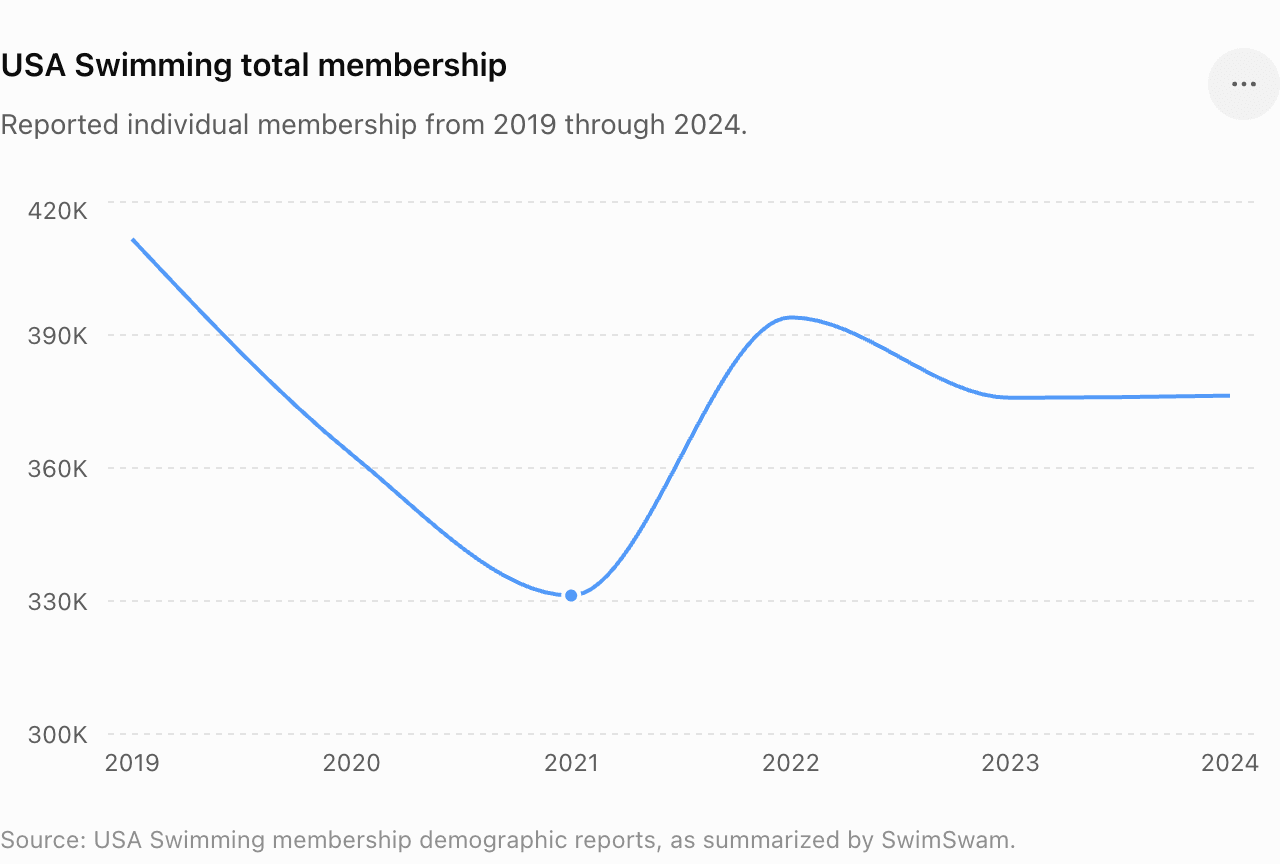
The graph tells an important story.
Swimming has recovered much of its participation since the lowest pandemic-era point, but growth is not automatic. Programs must continue improving the athlete experience if they want swimmers to remain engaged.
That responsibility falls heavily on coaches.
Coaches Are Responsible for More Than Training
A modern swim coach must be able to:
Teach technically sound movement
Design appropriate training
Analyze races and performance
Motivate athletes at different stages
Communicate with parents
Build a positive team culture
Use technology without losing the human side of coaching
USA Swimming’s coach-development offerings now include academies, regional clinics, webinars, workshops, club leadership education, and programming resources. The range of these offerings reflects how broad the coaching role has become.
A coach may understand physiology but struggle to communicate. Another may build strong relationships but lack a clear development system. The strongest coaches learn how to connect technical knowledge, leadership, and practical application.
Retention Must Become a Coaching Priority
Getting athletes into swimming is only the beginning.
Keeping them engaged is the greater challenge.
Broader youth-sports research has found that many children leave organized sports around age 11, often because the experience is no longer enjoyable.
For swim coaches, that raises important questions:
Do swimmers understand why they are training?
Can they see their improvement?
Do they feel known and valued?
Is the environment challenging without becoming overwhelming?
Are practices developing skills as well as conditioning?
Are coaches building confidence or only evaluating performance?
Retention is not separate from performance. Athletes must remain connected to the sport long enough to develop.
Data and Video Are Changing Coaching
Swimming is one of the most measurable sports.
Coaches can evaluate:
- Race splits
- Stroke count
- Stroke rate
- Distance per stroke
- Turn time
- Underwater distance
- Breakout timing
- Pace consistency
USA Swimming’s Data Hub provides access to performance information, rankings, records, meet results, and analytics, demonstrating how central data has become to the sport.
However, information alone does not improve performance.
The coach must translate data into an actionable decision.
For example:
A swimmer does not necessarily need to hear that their stroke rate dropped. They need to understand when it dropped, why it mattered, and what they should change in training.
That is where video analysis becomes especially powerful. It helps swimmers connect the coach’s explanation with something they can actually see.
What Swim Coaches Need Most
The modern coach needs an integrated approach built around four areas:
Education
Coaches need practical instruction that can be used immediately on deck.
Performance
They need systems for evaluating technique, training, and race execution.
Leadership
They must know how to motivate athletes and create a healthy team culture.
Technology
They need tools that save time and make feedback clearer—not technology that creates more work.
These four areas form the foundation of Elite Swim Training.
Why I Created Elite Swim Training
After more than 16 years of experience across age-group, high school, club, collegiate, and elite-performance settings, I have seen how difficult it can be for coaches to find education that is both credible and practical.
Some resources are too general. Others provide strong theory but little guidance for daily coaching.
Elite Swim Training was created to bridge that gap.
The goal is to provide coaches with:
Practical courses and certifications
Masterclasses and continuing education
Books and coaching resources
Training and technique guidance
Video-analysis tools
Performance and athlete-development systems
Every resource should answer one question:
How will this help a coach make a better decision or create a better experience for an athlete?
The Future of Coaching
The future of swimming will not be driven by technology alone.
It will be led by knowledgeable coaches who know how to combine:
Experience
Relationships
Sport science
Leadership
Data
Video analysis
Athlete-centered development
The coaches who continue learning will be the coaches best prepared to develop the next generation of swimmers.
That is the mission of Elite Swim Training:
Develop better coaches. Build stronger swimmers. Create lasting impact.
— David Hill
Founder, Elite Swim Training